


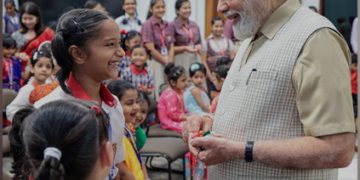











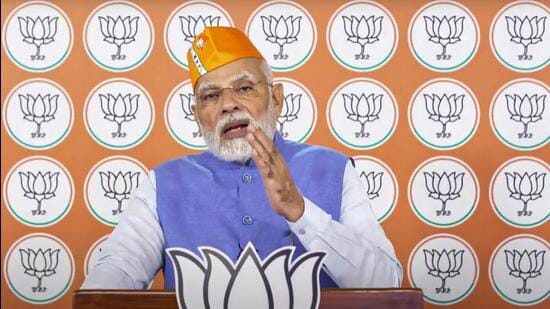

Prime Minister Narendra Modi on Tuesday called for a focus on creating economic opportunities in tier two and three cities for making them centres of economic activity to ease the pressure on bigger cities and a roadmap for the urban development for the next 25 years for setting the ball rolling for sustainable development.
“Urbanisation will happen and the populations in cities will go up. Mayors need to ensure that their cities have economic opportunities. The Union budget has focused on urban planning. It is important to ensure that planning is decentralised. Everything cannot be done from Delhi,” he said in his virtual address to a conference of Bharatiya Janata Party’s mayors and deputy mayors in Gujarat’s Gandhinagar.
He cited his experience of developing satellite towns when he was the Gujarat chief minister and said transport services were provided in the 40-50 km area around Ahmedabad to develop smaller cities so that people would not have to travel to bigger ones.
Modi spoke about the potential of smaller towns and cities as economic centres. “Apart from satellite towns, we need to focus on tier two and tier three cities because these can also be centres of economic activity. Most of the start-ups now are being set up in tier two and tier three cities…This will ease the pressure on the bigger cities and economic opportunities in those places will be provided. We should also increase industrial clusters in such places and understand what are the opportunities to be explored.”
Modi called for standardisation in urban planning and capacity building and putting an end to casual and ad hoc planning. “If you plan well, you will see good results. We need to have transparency in decision-making and focus on how the urban local bodies can be made self-reliant.”
Modi, who has pushed for public participation in campaigns for cleanliness and conservation of resources since becoming the Prime Minister in 2014, asked mayors to focus on awareness for the spending on infrastructure. He said school students particularly should be made aware of spending on public infrastructure to create a sense of responsibility.
Modi called for a need to draft policies for the street vendors. “The smaller roadside sellers are the ones who serve the city the most and are the driving force of the economy. Do we have a plan for them?”
He asked mayors to encourage the vendors to utilise PM SVANidhi, which seeks to facilitate collateral-free working capital loans. Modi called for the need to change habits and for bringing behavioural changes. “…some people clean their homes and leave rubbish outside others’ houses; that has to change. We have to teach them how to save power, water and pay taxes on time and undertake cleanliness drives. This will require a lot of hard work but the mayors can do it easily,” he said. He added that not everything requires money and most of the work can be done through public participation.
Modi asked the mayors to focus on solid waste management and to come up with scientific solutions to global warming. He called for organising competitions to judge the beautification of cities and said there should be city museums documenting history. “Had we been political about the Azadi Ka Amrit Mahotsav [celebrating 75 years of India’s independence] we would have created a pillar or a victory monument or a gate to commemorate Independence… But what we did was to create water bodies as this will serve humanity. This is how we will commemorate our independence and also create things for the future.”