




















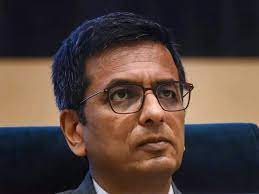

Chief Justice of India DY Chandrachud on Saturday said the first challenge of the judiciary is the challenge of expectations and a culture of distrust owing to which almost all cases fall onto the lap of the Apex Court. He also touched upon the issues of live-streaming of cases and connected it with that of the participation of women in the male-dominated judiciary. Justice Chandrachud was speaking at the 20th edition of the Hindustan Times Leadership Summit, 2022.
Here are the top quotes from the CJI’s address:
1. “Judges often come across to people as old-fashioned octogenarians because of our gowns and imposing behaviour and the sonorous voice adds to that.”
2. “One question we face is why we speak in different voices in the Supreme Court, why there are more men than women in the judiciary etc.”
3. “Indian judiciary has traditionally been the platform for resolving disputes between citizens in the city, between one state and another and between the states and the Union government.”
4. “Should a Supreme Court judge be dealing with a small pension case? To this question, my answer is obviously, we do. Because there is a culture of distrust and people believe they will get justice in the courts. This is also the reason for the pendency of cases.”
5. “Social media has posed a challenge for our times. Everything said by a judge in course of a case hearing is not what is the final view.”
6. “There are two types of judges in court – one who plays the devil’s advocate and the other who tries to extend the argument to a logical conclusion. So there is a free-flowing dialogue when a case is heard.”
7. On live streaming, Justice Chandrachud said, “Sunlight is the best disinfectant. One of the greatest dangers to the institutions in a constitutional democracy is the danger of being opaque. When you open up your process, you generate a degree of accountability, transparency, and a sense of responsiveness to the needs of citizens.” He said live streaming improved the participation of women lawyers.
8. “The structure of the legal profession even today across India is feudal, patriarchal and not accommodative of women.”
9. “Entering chambers of senior counsel — it’s an old boys club. How do you gain access to chambers? By tapping your connections and networks. Until we have a democratised and merit-based access to the entry point in the legal profession, we won’t have more women”. And merit is not all about who speaks English better or who went to which college, the CJI said.
10. “It is wrong to postulate that a woman judge will be more liberal. It is a wrong assumption. That’s not my thesis. My thesis is that there is something intrinsic about gender which adds to decision-making. Irrespective of the outcome that you arrive at an individual case, which brings to the case, a more deliberative, consultative and dialogic process to the art and science of judging.”