



















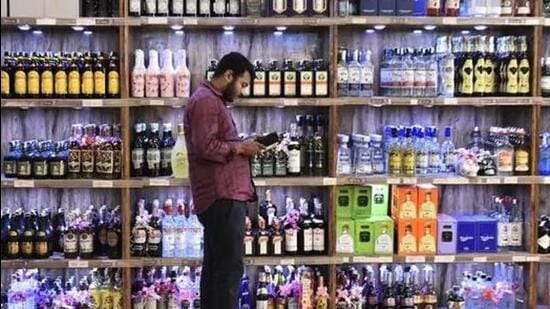

The Delhi government has collected ₹768 crore excise revenue in 30 days from excise duty, VAT, license fees, etc. under the current excise regime (old excise regime) in which four Delhi government agencies are running 400 liquor stores across the city, said a senior official of the excise department.
The four government corporations together sold around 20.5 million bottles of liquor in 30 days which, excise department officials described, as normal sale figure of liquor bottles in the month of September. The old excise policy was implemented from September 1 after the Delhi government decided to set aside the new excise policy 2021-22 as lieutenant governor (LG) VK Saxena recommended a Central Bureau of Investigation (CBI) probe into alleged irregularities in its implementation.
The excise department official said the ₹768 crore figure includes excise duty ( ₹460 crore), ₹140 crore (estimated) from VAT and revenue from license fee. “We are compiling the data because the sale will continue till the end of the day. The data compilation may take some days,” said the official.
The four government corporations together sold around 20.5 million bottles of liquor in 30 days which, excise department officials described, as normal sale figure of liquor bottles in the month of September. The old excise policy was implemented from September 1 after the Delhi government decided to set aside the new excise policy 2021-22 as lieutenant governor (LG) VK Saxena recommended a Central Bureau of Investigation (CBI) probe into alleged irregularities in its implementation.
The excise department official said the ₹768 crore figure includes excise duty ( ₹460 crore), ₹140 crore (estimated) from VAT and revenue from license fee. “We are compiling the data because the sale will continue till the end of the day. The data compilation may take some days,” said the official.
The four corporations have together opened around 400 liquor stores in the capital and 500 brands of liquor including Indian made foreign liquor as well as foreign liquor are available in the stores. “We are trying to open more liquor stores and by the end of October we will try to open 500 liquor stores. Almost all popular brands of liquor are now available in the liquor stores,” said an official.
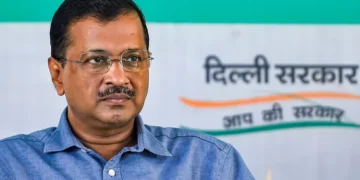
Excise revenue was one of the biggest reasons for a war of words between the LG and the Aam Aadmi Party (AAP) government. While the LG claimed loss of revenue due to irregularities in the framing and implementation of the policy, the AAP government initially dismissed the claims but later accepted the loss of revenue.
The Delhi cabinet, led by chief minister Arvind Kejriwal, in a Cabinet note switched back to the old excise policy and endorsed the data that during the first quarter, ₹1,485 crore was realised, which was 37.51% below the budget estimates for 2022-23. Also, a revenue decline on account of surrendered zones was estimated to be around ₹193.95 crore per month, despite no decline in the sale of liquor in Delhi. The AAP, however, says that the main reason behind the problems was that the former LG Anil Baijal changed a policy clause at the last minute, leading to hundreds of vends not being opened in locations where they would have been set up.
Under the currently implemented excise regime the VAT is 25% on the wholesale price of liquor which was reduced to 1% under the new policy. In the currently implemented policy the excise duty varies according to brands and is up to 300% on some products. The license fee for government run liquor vend is ₹4 lakh for a year while licence fee for a zone under the new policy was around ₹250 crore and 27 liquor vends were allowed to be opened in one zone. The commission for wholesalers has decreased from 12% under the new policy to 5% under the old policy. The brand licence fee is now ₹25 lakh under the old policy which was reduced to only ₹1 lakh under the new policy.
An official said that the excise department has developed an android based mobile application ‘m-Abkari’ to enable people to access location of retail vends and availability of a particular brand in a particular retail vend.
Vinod Giri, director general, Confederation of Indian Alcoholic Beverage Companies (CIABC), said the transition from the new to the old policy was relatively smooth even though people had to struggle due to non-availability of many brands. “Now that one month has passed since the transition, the government should aggressively pursue opening up of more liquor outlets and ensuring that more brands, especially premium ones, are available in the market,” said Giri. Also, there are other long pending issues such as liquidation of leftover stocks that need to be given priority, he added.